Consider the Ants - Sample Lesson
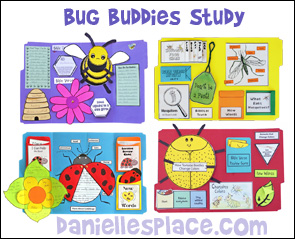
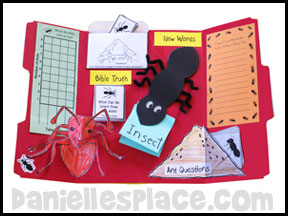
Bug Buddy Study for Home School (Including Lapbooking Materials)
Bible Reference:
Proverbs 6:6-8
Teaching Concepts:
Biblical: We can learn from the ants and become wise. The ants do their work even when they don't have someone telling them what to do.
Scientific: Every ant in the colony has an important job to do. They work together for the good of the colony.
Bug Buddy Study
Preparation: Before class set up a trail in a separate room or down the hall. You can use stickers or pieces of paper. At the end of the trail hide pieces of paper with one each of the following words written on them. "We can do our work without being told to do it." Write numbers on the backs of the paper in the order of the sentence so you will know where to place each word.
Have you ever stopped to watch a colony of ants next to their anthill? What did you see? Let your children share their thoughts.
You probably saw the ants all scurrying around in all different directions going in and out of the anthill, bringing in bits of animal parts, seeds, and other things and bringing out little rocks and plant materials. They all seem to be doing something, don't they?
Did you ever see any of the ants just sitting around watching the other ants work? Did you ever see an ant just sitting there waiting for someone to tell him what to do? No, every colony of ants has a queen ant, but she doesn't tell them what to do. She doesn't organize them or give them pep talks. She's too busy laying eggs. She lays eggs all day long.
All the ants in the colony have a job to do. There are lots of things to do in an ant colony. Some of the ants help take care of the larva or baby ants. The anthill has to be kept clean and in good repair. New quarters have to be built as the colony grows. The anthill has to be protected. Some of the ants have to go out and find food and then carry it back to the nest. All the ants have a job to do and they do it. They don't worry about whose doing what or how hard they're working. They see something that needs to be done and they do it.
They don't need someone to tell them it is time to get to work, or remind them what has to be done. They just do whatever they can to keep the colony going. What would happen if the ants didn't do this? They probably wouldn't get much done. What if a little ant saw some garbage or trash lying on the floor of the colony and she said to herself, "I didn't put it there, so I'm not picking it up. I didn't make the mess, so I don't have to clean it up." The colony would soon become clogged with garbage, wouldn't it? God made the ants. He gave each one a job and they do it. They don't need someone telling them what to do all the time. They just do it.
Did you know that the Bible tells us that we can learn from these little ants? That's right. (Open your Bible and read the verse.) In Proverbs 6:6 it says, "Go to the ant, thou sluggard; consider her ways, and be wise." Now we are going to find out what the ants can teach us and how we can be wise. (Write on the board "What can we learn from the ants?" An ant has left us a scent trail and the answer to this question. (Show the children the beginning of the trail. Have one child at a time follow the trail and bring back one piece of paper with a word on it. While a child is following the trail have the other children try to figure out the answer to the question by reading the words that the children have already found. You can also ask them what they think we might be able to learn from the ants. Continue until all the words are brought back and they know the answer.)
Ants don't have anyone to guide them and tell them what to do. They don't have someone watching over them to make sure they do their jobs right. They know what they are supposed to do and they do it. They don't need someone to make sure they do it and do it right. This verse is telling us that we should be more like the ants. When we see something that needs to be done, we should do it. We shouldn't have to wait for someone to tell us to do it. If you see a crayon on the floor, you should pick it up. You know crayons don't belong on the floor and they can get stepped on and squished if they remain on the floor. Even if you didn't use the crayons, you should still pick it up because it needs to be picked up. You don't have to wait for your teacher to tell you to pick it up. You can be wise and decide for yourself that that is the right thing to do.
How many of you have chores? What kind of chores do you have? Let the children respond. Do you wait for your mom or dad to tell you to do your chores, or do you do them because you know you have a job to do? Your parents shouldn't have to tell you to do your chores everyday. You should try to remember what you are supposed to do and do it without someone having to tell you to do it or remind you everyday. The older you get the more jobs and responsibilities you will have. Your parents can't remind you every day to do everything you are supposed to do. A wise child will try to remember what he is supposed to do and do it without having to be told. Can you think of some things that you are supposed to do that you can try to remember to do without having your parents tell you each time? (Let the children respond.) Here are some examples: Make your bed, brush your teeth, comb your hair, pick up your toys when you are done playing, clean off the table after you are done eating, do your chores, etc. When you do these things without be told, you are being wise like the ant.
What are some of the jobs Jesus wants us to do? Show people we care, listen to others, share our faith, invite a friend to worship, help to keep the church clean, etc. Do we have to wait for someone to tell us to do these things? No, if we are wise we just do them because they need to be done.
Copyright 2008, Digital by Design, Inc. - See Copyright Information
Biblical Truth
Bible Verse Review Fan-Folded Book
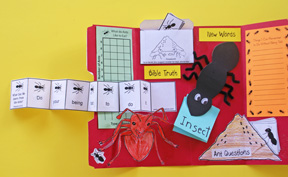
1. Print out the pattern and cut them out. Do not separate the pages.
Member's 
2. Glue them together to make a long page as shown in the picture above.
3. Cut the words apart and mix them up.
4. Have your children glue them to the book in order,and then fan-fold the pages with the cover page on top. (he last page is blank.)
Make a List
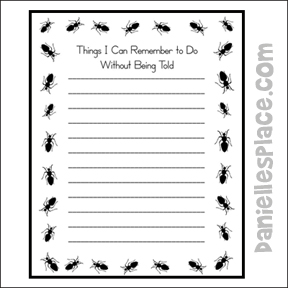
Print out the ant paper and make copies. In class have the children make a list of things that they will try to remember to do without having to be reminded.
Member's
Review their list each day. When you see your child doing something without being told, you can compliment him and tell him what a good little ant he is being.
Preschool children will have a hard time remembering to do things without being asked, but you can give them little reminders during the day without actually asking them to do something. For instance, at bed time you might say, "It's almost time to go to bed, I wonder what a wise little ant would do before he goes to bed?"
When your child remembers to do something without being told place an ant sticker or a star on their ant paper next to the thing they remembered to do.
Copyright 2008, Digital by Design, Inc. - See Copyright Information
Bible Verse
Bible Verse Envelope with Cards
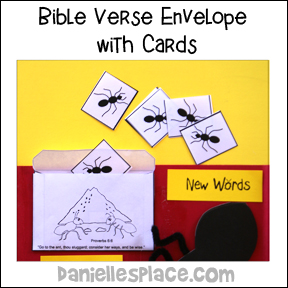
1. Print out the pattern on to card stock, and cut them apart.
(Pattern available to members on The Resource Room.)
2. Write the Bible verse on the cards, one word per card.
3. In class have your children color the envelope. Then have them mix up the cards and try to put them back in order.
You can make two sets for each child and have them play a match game.
Copyright 2008, Digital by Design, Inc. - See Copyright Information
New Words
New Words - Paper Ant
What you will need:
Black Poster Board
Black Pipe Cleaners
Wiggly Eyes
Hole Punch
How to Make Paper Ant:
1. Before class print out the ant pattern and cut the shapes from black poster board. You will need two ant shapes per ant.
Free Instant Digital Download
2. Use one pattern to punch holes in the ant's body where indicated with a very small hole punch. Don't use a hole punch that makes big holes. If you don't have a small hole punch, use a large needle. Put a white mark over the hole with some chalk so the children can find the hole. Punch holes for the antenna in the other body pattern.
3. Cut pipe cleaners in half for the legs. You will need two and one half pipe cleaners per ant.
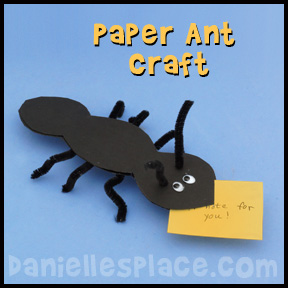
4. Stick the half pipe cleaners through one hole on the side of the ant's body and bring it under the body to the corresponding hole on the other side of the ant's body. Show them how to bend the legs. Do this for the other 2 sets of holes. When all the pipe cleaners are in place tape them down on the under side of the ant. Use the other half pipe cleaner for the antennas. Glue the two patterns together so that the pipe cleaners going across the pattern are on the inside. Don't glue the mouth closed.
5. Glue wiggly eyes on the face.
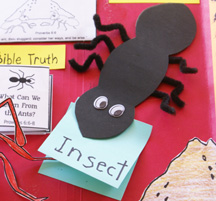
6. As your children read about ants have them write words on stick notes that they do not know. Order children can write the definition on the back of the sticky notes.
Copyright 2008, Digital by Design, Inc. - See Copyright Information
Read a Book About Ants
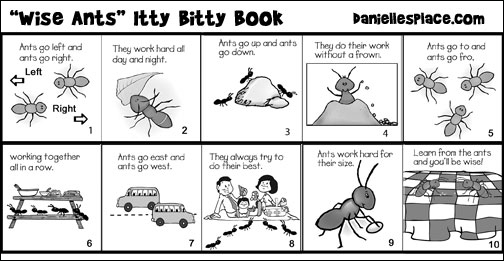
Beginning readers will enjoy this Itty Bitty book. (Pattern available to members only.)
Hands-on Learning Activities
Color a Picture
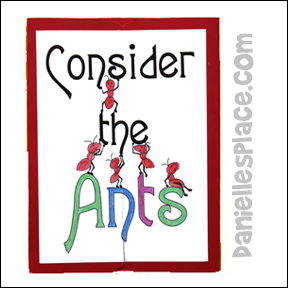
1. Print out the "Consider the Ants" Pattern and have your children color it.
Member's
2. You can use this picture for the front of your folder.
3. Open up the folder and fold the two ends in towards the middle.
4. Glue the picture on one side and them cut the picture in half along the folder edge line.
5. Glue the other half of the picture on.
Pop-Up Ant
What you will need:
White or Colored Printer Paper
Scissors
Elmer's Rubber Cement
How to Make Pop-Up Ant:
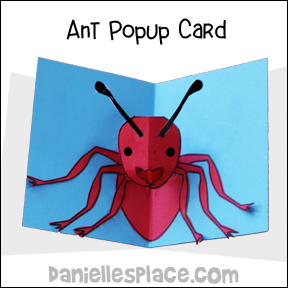
1. Print out the ant pattern and cut the body parts.
Member's
Use colored paper if you don't want to color the ant.
2. Fold the head and thorax pattern in half with the face on the outside as shown in the picture. Fold the pattern in half lengthwise so that you only see half the head.
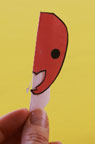
3. With the head facing you fold up the two small tabs at the bottom of the pattern.
4. Fold the abdomen pattern in half on the dotted lines so that the printed side is inside.
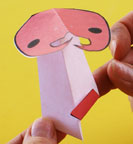
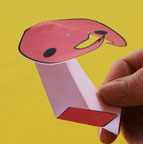
5. Place glue on the two triangular shapes on the abdomen pattern.
6. Match up the tabs on the head and thorax pattern to the abdomen pattern as shown in the picture.
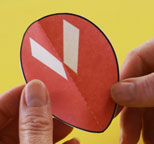
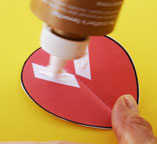
7. Carefully fold the abdomen pattern again pushing the head and thorax down into it as you fold. Crease them flat.
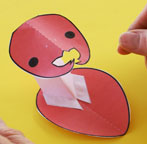
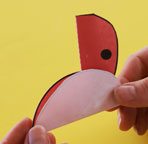
8. Glue the back of the abdomen to the inside of a folded card matching the folds. Glue the legs underneath the head near the thorax. Glue on the antennae (There are straight ones and folded ones so you can pick the ones you like best.
Styrofoam Ant Craft
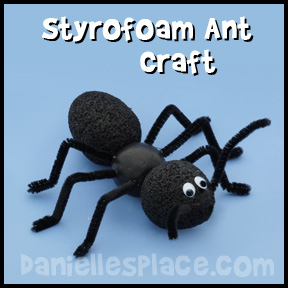
What you will need:
Two - 2 1/2" Styrofoam Eggs
One-half Inch Styrofoam Ball
Four Black or Red Pipe Cleaners
Wiggly Eyes
Black or Red Acrylic Paint
Toothpicks (The Large Type)
How to Make Styrofoam Ant Craft:
1. Poke two toothpicks halfway into the big end of both egg shapes. Press the ball onto one egg shape and then press the other egg shape onto the other end of the ball shape.
2. Paint the ant with black or red acrylic paint
3. When the paint is dry cut the pipe cleaners in half, save two halves for the antennae. Fold the other halves in half and twist the ends around each other. Insert the folded pipe cleaners (pointy ends into the Styrofoam) into the middle of the body for legs. Fold them to look like ant legs. Insert the reserved half pipe cleaners into the head and glue on eyes. As you work talk about the different parts of an ant: head, thorax, abdomen, legs, antennae, etc
Play "Ant House"
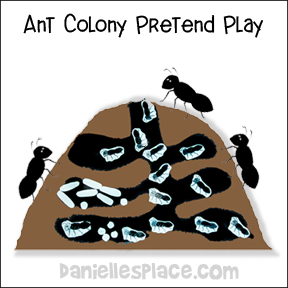
Help your child draw an ant colony on a big sheet of construction paper or poster board. Use the big Ant Pattern or small ant patterns to play "house".
Member's
Cut out egg and larva shapes. Decide which rooms will be the pantry, the nursery, the queen's quarters, etc.
Your children will love playing with all the little ants .They can go out
and look for food, fight off enemy ants, take the larva out on a sunny day, clean out the hive, etc.
Children of all ages will love this project. My daughter used black poster board for the background. Then she drew the ant rooms onto a piece of big fun foam. She then cut the rooms out leaving the surrounding dirt. She glued this piece to the black poster board. This gave it a little bit of a 3D effect.
Copyright 2008, Digital by Design, Inc. - See Copyright Information
Digging In Experiments
Study Ants


Set up an Ant Farm and watch the ants work, or go for a walk and look for ants.
Ask your children questions like " What are they doing? Follow them back to their homes.
Set out a plate of different foods near an anthill. At the end of the day go out and check up on the plate to see if any ants have come for a meal. Try to see if you can determine what they liked best. Older children will enjoy graphing the results. See the math section for more information.
What Do Ants Eat?
Print out the Ant Graph Paper Worksheet.
Member's
Take a paper plate and divide the paper plate into four sections with a black marker. Place a different type of food in each section. Write the type of foods you used on the work sheet. Place the paper plate on the ground near an anthill. (You may want to place a rock on the paper plate if it is a windy day so it doesn't blow away.)
Wait about an hour and then go back to check on your plate. Count how many ants are on each section. Graph them on the worksheet. If you have more than one child, have each child prepare a plate using the same foods, but place them in different locations. When they are done graphing, have them compare their graphs.
God Created The Ants Worksheet
Children learn about the Parts of an Ant, and write the numbers, one, two, three, and six.
Label Parts of Ants
Enchanted Learning has an ant printout that older children can use to learn the parts of ants.
Observe Ants
There is no better way to learn about ants than to observe them in a real life habitat. You can order them online or buy them at a local educational store.
Ant Questions
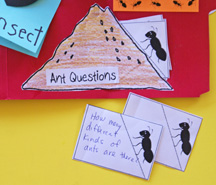
As you read about ants have your children write questions about what they have learned.
Print out the Ant Questions and the Ant Hill Pattern onto card stock and cut them apart.
Member's
Use the anthill pattern as a template to cut another anthill shape. Glue the shape to the back of the anthill pattern around the edges to make an envelope.
Write the questions on the front of the cards and the answers on the back.
Copyright 2008, Digital by Design, Inc. - See Copyright Information
Books

Those Amazing Ants by Patricia Brennan

Children of all ages will love this book! I loved this book because the pictures were so amazing. I wanted to reach down and pick up the ants, especially the ones that were all curled up sleeping. The artist made them look so appealing and interesting.
You may be able to find it in your local library. If not, Amazon.com has used ones. They may even have one in paperback. Just click on the picture to the left to go to Amazon. If you click on the link "Search inside this book" under the picture of the book on Amazon.com, you can see the picture of the ants curled up sleeping.
Young Naturalist's Handbook: Insect-lo-pedia
by Matthew Reinhart

Young Naturalist's Handbook: Insect-lo-pedia
Loaded with information about insects the cartoon-like illustrations and jokes scattered throughout the book give the book an upbeat feeling. It's very helpful in getting your children interested in insects, and is a great supplement to these lessons.
Web Sites
Wikipedia - https://en.wikipedia.org/wiki/Ant - Be very careful when getting information off this site. It is not always accurate and often biased. The ant information has a section on evolution stating that ants evolved from bees and wasps, and give no scientific proof of this. In fact, there is not scientific proof of species evolving from another anywhere, and is anti-biblical. It also states that the world is millions of years old which is against what the Bible teaches. If you were taught this in school and still believe it please check out Answers in Genesis. It is a great web site that explains why evolution is only a theory and the concept of millions of years is not accurate.
Other Lessons in this Series
Honey Bees
Created for a Purpose
Golden Tortoise Beetle
Changing Colors
Introduction
Seek and Find
Goliath Beetle
The Best Kind of Armor
Antennae
Feel for Others
Water Strider
Keep Your Eyes on Jesus
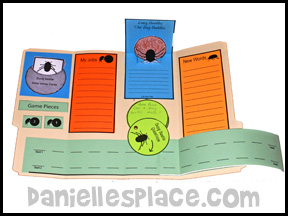
Dung Beetle
Work for the Lord
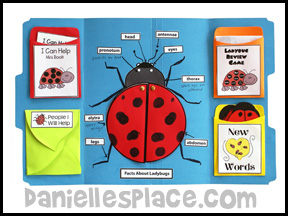
Ladybug
Real Friends
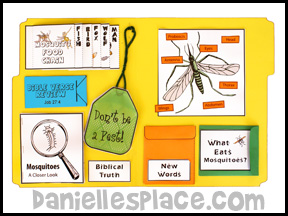
Mosquitoes
What Kind of Friend Are You?
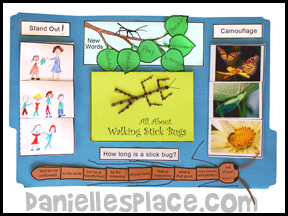
Walking Stick Bug
Standout for Jesus!
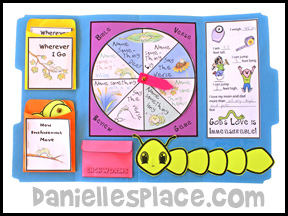
Inchworm
God's Love is Immeasurable
Copyright © 2008, Carolyn Warvel
Danielle's Place of Crafts and Activities
https://www.daniellesplace.com
All rights reserved. No part of this publication may be reproduced or transmitted in any form or by any means, electronic or mechanical, including photocopying and recording, or by any information or storage retrieval system, except for local church or school use only. This copyright notice must be included on all copies. Requests for permission to copy this material for any other uses should be addressed to Carolyn Warvel, 588 Duran Street, Henderson, NV 89015 or e-mail me at care@daniellesplace.com