Crafts and Learning Activities Elements of Design - Color
Including Books about Art, Art Activities, and Printouts
Doodling - Learning About Line, Shape, Color, and Value
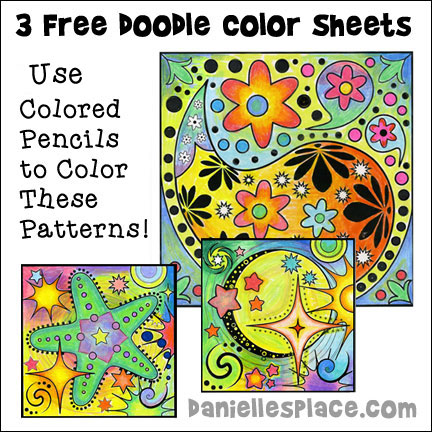
Doodling is a great way for children and adults to practice artistic techniques. No only do they provide practice with lines, shapes, color and value, but are great for experimenting with mixed media such as colored pencils, markers, highlighters and water colors.
A good way to learn how to doodle is to print out some doodle patterns and color them. Add some of your own doodles to the pictures and then try making your own doodle art from scratch.

Use these three free doodle sheets to get started:
Member's 
Free Instant Download 


We recommend using Prismacolor Premier Colored Pencil because they have very soft lead, provide a large variety of deep colors or soft colors depending on how hard you press. They are also great for blending and shading.
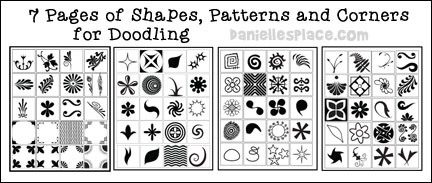
Printable Swatches for Doodling: Shapes, Textures, and Corners
Member
Instant Digital Download - 
"Mouse Paint" Mixing Colors Activity
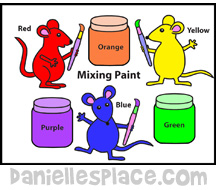


Three white mice have fun learning about mixing colors.
Watch "Mouse Paint" on Youtube.com or read the Book to your children.
1. Use the activity sheet and have your children practice mixing the primary colors to make secondary colors. (This activity sheet is available to members on The Resource Room.)
Member's
Color Wheel and Terms Relating to Color
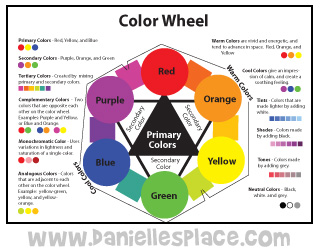
Review the following terms and have your children point them out on the color wheel.
Primary Colors - red, yellow and blue.
Secondary Colors - purple, orange, and green.
Tertiary Colors - The six colors created by mixing the primary and secondary colors that are next to each other on the color wheel.
Complementary Colors - Two colors that are opposite each other on the color wheel.
Monochromatic Colors - Are variations in lightness and saturation of a single color.
Analogous Colors - Colors that are adjacent to each other on the color wheel. For example, yellow-green, yellow, and yellow-orange.
Warm Colors - are vivid and energetic, and then to advance in space. Colors with red, orange, and yellow are warm colors.
Cool Colors - are calm and soothing. Colors that include glue, green and purple are cool colors.
Tints - are colors that are made lighter by adding white.
Shades - are colors made by adding black.
Tones - are colors made by adding grey.
(This color wheel printout is available to members on The Resource Room.)
Member's
©2012, Digital by Design, Inc. - See Copyright Information
"The Little White Owl"


Little White Owl by Jane Chapman
Little White Owl lives all alone in the snow, but he doesn't mind so much because his head is filled with happy stories. One day he decides that it is time to go see the world, and he discovers a place that is occupied by beautiful colorful owls, owls just like him, or so he thinks. When he tries to be friendly with them they are standoffish and tell him he doesn't belong with them because he doesn't have any colors. Little Owl disagrees and says, "But I do have colors . . . here in my heart! . . . I'll share them with you if you want?" Though the colorful owls were reluctant to listen to them at first, they find that they enjoy Little White Owl's stories and ask for more. When it is time to go home the pretty owls ask to come with him, and the Little White Owl leads them to his home. They become good friends and promise to visit each other often.
Color Discussion
Have your children look at the pictures of the Little White Owl in his white world at the beginning of the story. Ask them what colors they see and how the colors make them feel. Then have them look at the picture of his magical stories. Ask them what colors they see and how the picture makes them feel.
Make Colorful Owl Puppets
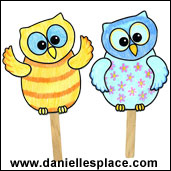
Have your children color the owl puppets and then write things of on the back side of their puppets that make them special. Use the puppets to act out the story. (Puppet patterns are available to members on The Resource Room.)
Member's
Owl Color Sheets
Using the Color Wheel Printout to review primary, secondary, tertiary, and analogous colors.
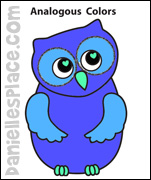
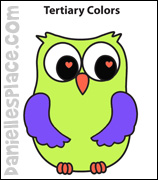
Have your children paint or color the owl color sheets representing the following:
Primary Colors
Secondary Colors
Tertiary Colors
Analogous Colors
Member's
©2012, Digital by Design, Inc. -See Copyright Information
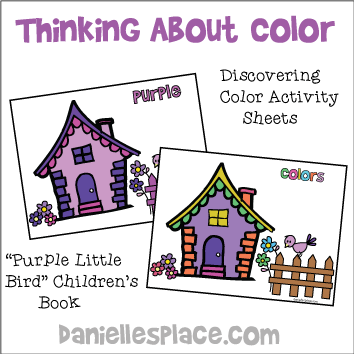
"Purple Little Bird" Activity - Thinking About Color
What you will need:
The "Purple Little Bird" by Greg Foley
Crayon or Colored Pencils - You will
need many different shades and values of purple
Printing Paper
How to Use this Activity Sheet:
1. Print out the patterns and make copies. (Available to members.)
Member's
2. Introduction to the Story
Ask your children what their favorite colors are, and if they choose items of this color when they have the opportunity. Ask them why they like the color and what they own that is that color. Ask your children if they would like their whole house and everything in the house to be their favorite color.
3. The Story - Discussion
Read the story about Purple Little Bird. When you are done ask your children what Purple Little Bird might have learned. Say that Purple Little Bird learns that too much of a good thing can be bad, and that moderation can be a good thing in life and in the colors we choose. You can also point out that variety can be interesting and exciting. If everyone and everything was the same, life would be boring.
4. Learn what Monochromatic means and study monochromatic works of art.
Monochromatic - Having only one color, represented by differing hues and tints.
Study artists who used monochromatic color schemes. Follow the links below. After your children have studied the images, ask them what they think about them. Then show them works by the same artist that aren't monochromatic, and ask them how they feel about them. Compare the different works or art.
Ad Reinhardt - Red Abstract and Abstract Painting, Blue compare these works with other works by the same artist
©2015, Digital by Design, Inc. - See Copyright Information
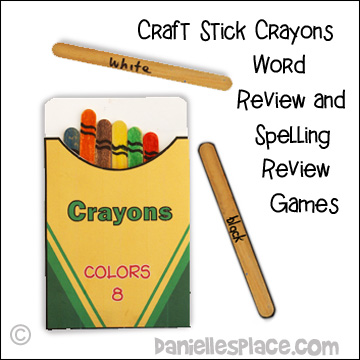
Crayon Box and Crayon Learn to Spell and Read Colors Game
What you will need:
Card Stock or Library Card Pockets
Craft Sticks (Popsicle Sticks)
Magic Markers
Glue
Scissors
How to Make The Crayon Box Spelling Game:
1. Print out the crayon box pattern onto card stock. (Available to members.) If you are not a member, you can use library card pockets instead. They are a little shorter, but you can cut the crafts sticks shorter to match the envelopes.
Member's
2. Have your children color the craft sticks different colors and then write the name of the corresponding color on the back of the craft stick.
How to Play the Crayon Spelling Game:
1. Remove all the crayons from the box
and turn them right side up so you can see
the colors.
2. Have your child say the name of the color and try to spell it, and then turn the crayon over to see if he is correct.
3. If he is correct, he can place the crayon back in the box.
4. Have your child keep playing until all the crayons are in the box, and he can spell all the words.
How to Play the Crayon Reading Game:
1. Remove all the crayons from the box and turn them over so that the words are showing.
2. Have your child read a word on one of the crayons, and then turn the crayon over to see if he is correct.
3. If he is correct, have him place the crayon in the box.
4. Have your child keep playing until all the crayons are in the box, and he can read all the words.
Spice Painting Art Activity - Including History, Biology, and Geography Activities
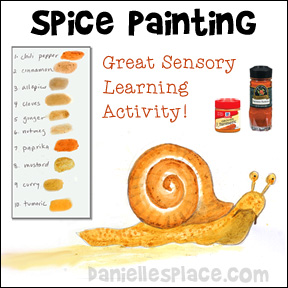
Spice up your painting experience! A great alternative to traditional paint media, spice paint introduces children to alternative methods of painting, promotes experimentation and creativity. Make this an even better home school learning activity by including the history and origins of spices. Include a geography lesson by looking the countries from which your spices came.
What you will need:
Spices from your Cupboard
Styrofoam Egg Carton
Paint Brushes
Water Bottle
Paper
Paper Towels
Pencils and a Sharpie Marker
How to Make the Spice Paint:
1. Write a number on each egg cup in the egg carton.
2. Measure out one teaspoon of a spice and place it in one of the egg cups. Write the name of the spice and the number of the egg cup on a sheet of paper. This will help you remember which spice is which.
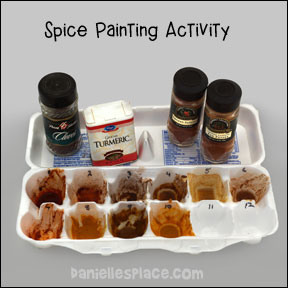
3. Add a teaspoon of water to the spice in the egg cup and mix it up with a paint brush.
4. When the spice is thoroughly mixed, paint a small patch of color next to the name of the spice. Do this for all the spices you use.
5. After your paint swatches have dried decide what you would like to paint using your new paints.
Learn More About Spices - Spices come from all over the world and are made from many different things such as herbs, tree bark, roots, rhizomes, and a combination of different spices. Print out the List of Spices with information on where they come from and what they are made from. If you are using a spice that is not on the list, look it up on the Internet. Look up the countries of origin on a map.
Crafts About Color on other Pages
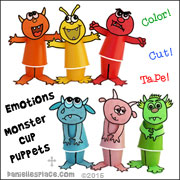
Use this craft to introduce your children to color theory.
Use these Paper Cup Monsters to talk about how color is often used to express emotions:
Seeing Red - angry
Blue - sad
Green with envy
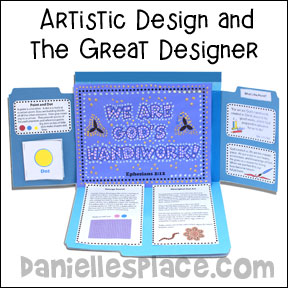
Artistic Design and the Great Designer
Christian Home School Art Lessons - Art Lessons on The Elements and Principles of Design from a Biblical Perspective