Welcome to Danielle's Place where you will find thousands of free crafts for kids designed to make learning fun.
Many of the crafts and activities are Bible-based and are great for use in Sunday school, preschool, home school, and on special occasions.
Educational CraftsCrafts and Activities for Popular Children's BooksStretch Yourself! Read a Book
|
Throw Your Tooth on the Roof
|
|
2. Talk about traditions and make your own book - Have your children talk to friends and neighbors (especially people from other cultures) about their traditions and how they celebrate special occasions. Pick one occasion such as Thanksgiving or Christmas and help your children make their own book using this book as an example.
Save your lost tooth for El Ratón, the mouse "tooth fairy" in this mouse-shaped pocket.
What you will need: Grey and pink felt, pink bead or pompom for the nose, small googly eyes, needle, black thread, and grey yarn or fake fur, small piece of Velcro, and a hot melt glue gun.
Coming Soon
1. Print out the patterns and cut the back and front of the head and the outer ears from grey felt. Cut the inner ears from pink felt.
2. Sew the back of the head to the front of the head and fold down the flap at the top of the head. Glue pieces of Velcro on the flap to keep it closed.
3. Sew on a bead for the nose and glue on the eyes.
4. Sew or glue the pink inner ears to the out ears. Glue the ears to the back of the head under the flap.
5. To make the whiskers thread a needle and insect it just about the nose on one side. Tie the end of the thread leaving the ends long. Bring the needle through the head to the other side. Cut the thread tie the ends so that the whiskers don't come out.
6. To finish glue some fake fur to the top of the head.
I Lost My Tooth in Africa"I Lost My Tooth in Africa" by Penda Diakité - Did you know that in West Africa children put their lost teeth under gourds and receive chickens from the African tooth fairy? This is an enlightening story about a little girl who visits her family in Mali, West Africa, and shares the different traditions she experienced there, including a visit from the tooth fairy. Learning Activities: 1. Talk about traditions - Have your children talk to friends and neighbors (especially people from other cultures) about their traditions and how they celebrate special occasions. 2. Learn African expressions and make African food - At the end of this book you will find a list of African expressions and an African Onion Sauce recipe. |
You can find more Teeth Crafts and Activities on the "Healthy Teeth - Crafts and Activities Page
Froggy Goes to School Paper Doll Activity - This activity goes with the book Froggy Goes to School by Jonathan London. If you can't find this book at your local library, you can buy it at Amazon.Com Froggy Goes to School
What you will need: paper, crayons, scissors and glue.
What to do: Have your children color the frog and then pick out the clothes pattern that best matches what they are wearing on their first day of school. Then color the clothes to match their own clothes, cut them out, and glue them on the frog.
Patterns for this craft are available to members only. Click here.
This paper plate frog can also be used as a craft to go along with this book. It's just not a craft though; children can use it as a carrying case to hold their vocabulary words and as a game to review their vocabulary words
You will find fun frog spelling and reading review games in the Educational Craftssection of this site. Children feed the frog words that are spelled correctly or words they can pronounce.
Leap into Learning! Bulletin Board Display
Patterns for this Bulletin Board Display
is available to members only. Click Here.
"Read it! Read it! Read it!" Frog BookmarksEncourage your children to read more books about Froggy by Jonathan London and have them use this frog bookmark to keep track of how many books they have read. Have them color a frog each time they read a book about frogs. You can give them a frog prize when they have colored in all three frogs.
Patterns for this craft are available to members only. Click Here
Oriental Trading Company has lots of inexpensive, frog-themed novelties and crafts. Just type in "frog" in the search box at the top of the page.
1. Great Smelling Strawberry Activity Sheet
What you will need: Paper, strawberry Kool-Aid (no sugar added), paintbrushes, and crayons.
What to do:
1. Print out pictures of strawberries or have your children draw them. (A pattern for the activity sheet pictured at the left is available to members of Danielle's Place.)
2. Mix a small amount of water with a packet of strawberry Kool-Aid to make paint.
3. Have your children paint the strawberries with the Kool-Aid mixture.
2. Feed The Bear Strawberries Review Game
What you will need: Card stock (Heavy Paper), crayons (Optional), and scissors.
1. Make a bear poster with a picture of a bear with his mouth open. (A pattern is available to members only.) Cut out the mouth so the strawberry pictures fit through the hole.
2. Draw pictures of strawberries or use the patterns and cut them out. (A pattern for the strawberries is available to members only.)
3. Write your child's vocabulary words, spelling words, etc. on the strawberries. If your child can read or spell a word that is written on a strawberry, he gets to feed the bear by placing the strawberry in its mouth. Keep playing until the bear has "eaten" all the strawberries.
3. "Match the Halves" Strawberry Game
What you will need: Card stock (Heavy paper), laminator machine (Optional), and markers.
What to do: Print out strawberry pictures onto card stock. (A pattern for the strawberries is available to members of Danielle's Place.) Cut the strawberries out and laminate them. You will be able to use them over and over if you laminate them and use a dry erase marker.
You can play many types of games with your child using these strawberries:
1. "Beat the Bear" Match Game - Lay out the strawberry halves in front of your child. Tell him that he is the little mouse and he needs to put the matching strawberry halves together as fast as as he can before the big hungry bear shows up. Set a timer and tell your child that he has a certain amount of time before the bear shows up. Give him plenty of time the first time. Play again and tell him that the big hungry bear is even closer and he must match the halves even faster this time. You can use a bear puppet or stuffed animal and move him a little closer. Give a few growls as he works. Each time he plays the game, shorten the amount of time. If he doesn't finish on time, "attack" him with the bear puppet, tickling and teasing him. Keep playing until he gets tired of the game.
2. Match Game - Turn all the halves over and take turns trying to find matches. Players take turn turning two halves over at a time. If they match, the player gets to keep the halves. If they don't match, the next player takes a turn. Keep playing until all the strawberry halves are matched up.
3. Find the Matching Half - Pass out halves of strawberries to children and hide all the matching halves. Have all your children try to find the half that matches his or her half.
These strawberries can be used to review many areas of study:
1. Lower and Upper Case Letters - Print the lower case letter on one half and the upper case on another.
2. Numbers - Print a number on one half and draw in the same number of seeds on the matching half.
3. Rhyming Words - Print a word on one half and a rhyming word on another half.
4. Review Math Facts - Print the problem on one half and the solution on the other.
Big Hungry Bear Activity Sheet - Draw a picture of what you think the big hungry bear in the story looks like. Go to Don and Audrey Wood's web site to print out the activity sheet.
How the Ilustrations were Made - Find out from the artist and author how the illustrations for the book were made.

"Working
Frog" by Nancy Winslow Parker - Crafts and Learning Activities - Children
pretend to be a zookeepers and keep records of the zoo's animals.
This
activity goes with the book Working Frog by Nancy Winslow
Parker. If you can't find this book in your local library, you can buy it at Amazon.com. Working Frog
Science Activities
1. Make an animal habitat - See the Frog Crafts Page for directions. Have your child pretend to be a zookeeper and fill out the acquisition forms and tank forms. He can keep the acquisition forms in a folder and tape the tank forms to the displays. Your child can make more than one display using toy animals, animals he makes, or real, live animals. For each animal research where they can be found and their habitat, what they eat, and fill out a form for each animal.
2. Research other animals - On page 37 Winston said there was also a Giant Toad, a Reticulated Python, and a Timber Rattlesnake in the zoo with him. Look up these animals on the Internet to find out more information about them.
3. Find out what amphibians and reptiles are.
4. Visit your local zoo.
5. Get your child's friends together and have them bring their animals to set up a zoo of their own. Invite your friends over. Let each child tell about his particular animal.
Math
1. Figure out how many people altogether came to peer at Winston the frog. Page 36 tells how many boys, girls, mothers, fathers, and teachers came to look at Winston. Have your child add them up to determine how many came altogether the first day. You can also make up a graph showing how many people came each day for a week and make up questions like:
1. On what day did the most people come to see Winston?
2. On what day did the least amount of people come?
3. How many people came during the whole week?
4. What was the average amount of people to come in one day?
Writing
1. Write a story about an animal that is captured and taken to the zoo using the book as a model. Tell children to pick an animal they would like to use in their story. Tell them to pretend to be that animal and think about what it would be like to be that animal, to be captured and taken to a zoo.
Use the same setup as the story, the first part of the story should be where the animal was captured, pond, river, desert, lake, etc and how he felt on his trip to the zoo. The story should be written in the point of view of the animal using the word "I" throughout the story.
The second chapter should be about arriving at the zoo, what the zookeeper did and how he felt in a strange new place.
The third chapter should be about settling into his new life and why he was there.
The fourth chapter should be about how he accepts or doesn't accept his new life as a working animal and the conclusion to the story.
The Boy Who Dreamed of an Acorn - by Leigh Casler, Illustrated by Shonto Begay, published by Penguin Books, 345 Hudson, NY, 10014.
This is a wonderful book about the gifts we are given and how we can learn to be happy with the way we were created. In this book a young Indian boy goes on a spirit quest to discover what his gifts are. He wanted to dream a powerful dream of a bear or mountain lion, but he only dreamed of a tiny acorn that seemed to him to have no power at all. He went to a wise man who told him, "To each a different gift is given, and to each a different dream does come. Be happy with your dream." This story is about how a boy learns to accept his gifts and learns that each gift has a different kind of power. (This book is currently out of print, but you may be able to find it in your library. If your library doesn't have this book, ask them to place a request for this book. If the publishing company gets enough requests, they just might put it back into print.)
The acron craft above can be found on the Thanksgiving and Fall Crafts Page.
| The Oak Inside the Acorn By Max Lucado / Tommy Nelson In his touching picture book, master storyteller Max Lucado reveals that each one of us was created for a special purpose. The Oak Inside the Acorn is a heart-warming parable that encourages children to be the best they can be for God. This parallel to the bestselling book for adults, Cure for the Common Life, reminds parents to focus on their children's God-given abilities, while Children will see that all they need to do is to "Just be the tree God made you to be." Little Acorn sees himself as very small and he's unsure of what he's supposed to do in life. Eventually, he grows into Big Oak, but he still wonders about his purpose. Though he tries as hard as he can, he can't grow oranges like his friends the orange trees, or produce beautiful flowers like his friends Pink Petunia or Rosie. But finally, he discovers that his mighty branches were created for a very special purpose! Recommended for ages 5 to 10. |
Activities to go along with these books:
1. Make an Acorn - You can use this pattern with the following poem written on it or you can use the blank acorn pattern and have the children write their own poem or write what they think might be their gifts. For directions and a pattern for this craft go to the Thanksgiving and Fall Crafts Page. "There's power in the acorn and there's power in me.
Just like the tiny acorn that grows to be a tree,
Whose branches reach to heaven for all the world to see,
When I reach up to thee, Lord, I'll become what I am supposed to be."
©2003, Carolyn Warvel Do not publish on other web sites without permission.
The Tiniest Acorn This is a great story for young children. They will identify with Lulu a tiny acorn that doesn't have any control over her world. As she is blown from place to place she meets other objects that have their place and a purpose in the world. She meets a tall pine tree that reaches up into the sky and shades everything below. This makes Lulu wonder what she can do. Lulu is blown into a field of daises that sway in the wind and brighten the fields. Lulu knows she isn't as pretty as the daisies, and wonders again what she can do. She meets other objects, and each time she compares herself to them. Finally she is discovered by a young boy who knows more than she does. He plants her in the ground. Lulu doesn't realize what is happening to her and is a little scared, but after a long time she learns that she has become a beautiful oak tree and that her purpose in life is to protect people from the sun and to share her beauty in the fall. But best of all she learns that she is to pass along her wisdom to her children and help them to realize their purpose. |

2. Print out an Itty Bitty Book About Five Little Acorns - Go to the Printable Books Page to get this pattern.
3. Acorn Shape Book - Children will enjoy making an acorn-shaped book. On the inside pages they can draw pictures of things they can do even though they are still small. Read Bible stories about people who did great things even though they were small such as the story of David and Goliath and Samuel as a young boy.
Print out the Acorn Cap Patterns onto brown paper and the Acorn Bottom Patterns onto tan paper. Cut them out and glue the caps to the bottoms. Use the finished acorn as a template to cut pages from white paper.
![]() |
God's Oak Tree by Allia Zobel Nolan This beautifully illustrated book is a great way to teach your children about God's Plan for the whole world. It tells the story about how God planned for a tiny acorn to become a mighty oak tree and produce more or its kind. As you turn the pages the acorn gradually disappears and a tree appears.
|
8. Color a Picture of an Acorn with a Poem - Before class print out copies of the following poem.
Be What You Were Meant to Be
Written by Carolyn WarvelI’m just a little acorn way up in a tree
I may not seem important, but God has a plan for me.
Someday I may become the tree inside of me.You don’t have to worry about what you cannot see.
Just put your trust in Jesus because he is the key.
He’ll help you to become the person you were meant to be.Leave room on the paper for your children to draw a picture of an acorn. (A pattern for this craft is available to members on The Resource Room.) In class have your children draw a picture of an acorn to go along with the poem. You can also make a frame for the picture by cutting off the sides and gluing the picture to a piece of construction paper. Have your child glue fun foam leaf shapes all around the edge. (Problems Printing?)
"If
You Give a Moose a Muffin" Moose Vocabulary Craft Page and Color
Sheet
What you will need: Paper, scissors, and glue.
What to do:
1. Print out the face pattern, and antler and muffin patterns.
2. Color the antler and face pattern. Cut out all the patterns. Use the muffin pattern to cut muffin shapes from construction paper.
3. Glue the antlers onto the back of the face.
4. On another sheet of paper draw a body shape as shown and color it. Glue the face pattern onto of the body shape leaving the mouth area unglued so that you will be able to stick muffins under the pattern.
5. Go to the Moose Crafts and Activities Page for directions on how to use this picture to practice vocabulary words.
Written by David Shannon (Ages 3 - 7)
One day down on the farm a goofy looking duck decides to ride a bike. He says hello as to all the different animals that that live on the farm as he rides by. They all say hi back in their won way, but what there really thinking is something completely different. Cat says, "Meow, but what she thought was, "I wouldn't waste my time riding a bike." She is seen laying on the ground licking her paw like she could care less. Horse says, "Ne-e-e-igh!". But what he thought was, "You're still not as fast as me, Duck!" He is pictured with his nose up in the air and glancing sideways at duck. Goat say, "M-a-a-a". But what he thought was, "I'd like to eat that bike!" He is shown with wide eyes staring at the bikes tires.
Creative writing - This is a great book to demonstrate repetition in writing. Your children can write their own pages to add to the story. Let them pick an animal and decide what he thought after saying hello to Duck. If you have beginning writers have them use the fill in the blank worksheet. More experienced writers can follow the pattern used in the book. They can then draw a picture illustrating their own page. Here is an example my daughter wrote. "Then Duck rode, no-hands, past armadillo. "Hello, Armadillo," said Duck. "Hello," said Armadillo. But what he thought was "He needs a helmet like me."Art - This is a great book to demonstrate perspective in drawing. We see the duck on a bike drawn from every perspective imaginable.
Vocabulary Review Game - This game is played like the Chinese tile game. Write the vocabulary words and review words on pieces of 4" x 2" sheets of paper. Pile the pieces of paper up with some covering each other. The object of the game is to uncover all the vocabulary words by saying them correctly. If a child says the word correctly, he can pick up the piece of paper. He can only say the words that are all the way uncovered.
The Grouchy Ladybug Learning Activities 1. "The Grouchy Ladybug" Ordinal Numbers Activity - Read "The Grouchy Ladybug" by Eric Carle. Tell your students to try to remember the order in which the grouchy ladybug visited each animal. After you have read the story, give each child a set of animal cards (Pictures of all the animals in the story - Patterns available on the Members Only Section) and see if he can place them in order. Or you can give each child one animal from the set. Read the story again so the children can check their answers. Then have them place the ordinal number cards next to the matching picture. If you have older children, have them write the names of the animals on a sheet of paper in order.
2. Make a Puppet Skit - Glue pictures of each animal in the story onto craft sticks to make puppets( Patterns available on the Members Only Section) Have your children make a puppet skit about the grouchy ladybug.
3. Make Ladybug snacks - Spread strawberry jelly on rice cakes to make the ladybug's body. Place raisins or chocolate chips on top for the spots.
4. Compound Word Bugs Game - Write the following words on cards: Lady, fire, yellow, walking, june, grass, bumble, wolf, cut, ear, swallow, butter. Write these words on a different color of cards: Bug, fly, jacket, stick, bug, hopper, bee, spider, worm, wig, tail, fly. (A pattern is available to members only.)
Mix the cards up and place one color on one side of the table and the other color on the other side of the table. Have your child try to match up a card from one side to a card from the other side to make compound words. Once your child knows which words go together play a concentration game. Turn all the cards over and take turns turning two cards over at a time. If they match, the player gets to keep them. The player who gets the most cards wins.
Draw compound bugs - Use the cards from the Compound Word Bug Game above. Mix up the cards and have your children pick two cards from each color group. Have them put them together to make a new type of bug, and draw a picture of the new type of bug.
5. Play a match game - Make ladybugs from red and black poster board. Draw spots on the ladybugs so that you have two cards with the same pattern on each. Let the children help you match up the ones that look the same.
Memory Games - Make all the ladybug cards look different and play a memory game. Write math problems on half the cards and the answers on the other half. Have your children play concentration. You can also use these cards to review vocabulary words or any other things you happen to be teaching.
6. Play "Fly In and Out of the Window Little Ladybug" - Have the children stand in a circle holding hands. Pick a child, or more than one child if you have a lot of children, to be the ladybug. Keep singing the following song over and over until the "ladybug or ladybugs" find their way back to their place by weaving in and out of the children's arms around the circle. "Fly in and out the window, fly in and out the window, fly in and out the window little ladybugs." (Sent in by Nancy Foss)
7. Make a ladybug craft - Go to the Ladybug Craft Page to find ladybug crafts to go with this book.
![]() |
![]() |
![]() |
![]() |
Links to Other Web Sites with Activities that go Along with Books
Denise Fleming's Web Site has crafts and activities that go along with her books, including paper crafts, word searches, bookmarks, finish the picture coloring pages, match up, snacks, etc. Some of the books include: Barnyard Banter, Buster, Count!, Mama Cat, Pumpkin Eyes.
The Red Bird - by Astrid Lindgren The one word that bests describes this book is hope. Any child who is going through hard times, struggles with a disability, depression, or sickness will be able to relate to this story. Although it is written like a fairy tale, it can be understood on a much deeper level. The author may not have realized her story mirrors the story of anyone who has found salvation and hope through Jesus' shed blood, but this story has so many correlations that I would find it hard to believe she didn't.
The story is about two orphan children who have no joy in their lives. They live with a farmer who does not love them and only took them in so they could help with the daily chores. The only thing that kept them going was the fact that they would get to go to school in the winter for a couple of weeks. But when they finally got to school they realized that it really wasn't all they thought it would be. I think this represents our lives without Christ. We think we will find happiness through our friends, popularity, a good job and other worldly things, but we soon realize that real joy can't be found in this world.
The children fill hopeless, yet keep trudging on through their gray lonely lives. One day, on their way home from school, the little girl decides that she just can't go on any longer. She wants to give up and die. That is when she sees the red bird. It brings hope back to her life. ("But now in Christ Jesus you who once were far away have been brought near through the blood of Christ. Eph. 2:12b-13") She knows she has to follow the bird or she will just give up and die. The children follow it through a narrow passage and it takes them to a wall with an open door. ( "But small is the gate and narrow the road that leads to life, and only a few
find it." Mt. 7:14) They walk through the door and find a paradise.
Every day after school they follow the red bird to this paradise where they play and are fed and clothed. But then they hurry back to the farmer to get their chores done. (I think this represents the times we go to Christ and find comfort in our daily struggles.) But soon the last day of school is upon them and they go to visit the paradise for the last time. But instead of hurrying home to milk and feed the cows that day, they close the door, which can never be opened again, and live in paradise forever. (Heaven is our real home and they finally got to go home.)
After reading this book to your children you, point out some of the correlations. Also talk about how the use of color sets the mood for the story. Point out the difference between the pictures of paradise and the gray wintry days in the story. Have your children draw pictures of their own to represent both a gray day and a bright sunny day. The Red Bird Card and the Ribbon and Bell Bird Craft can be used to go along with this story.
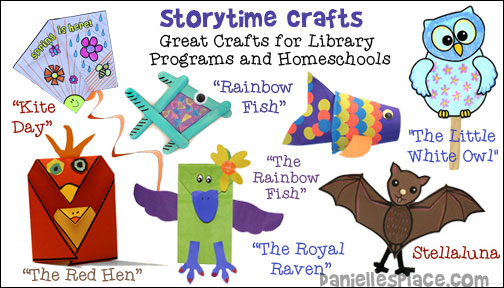
The Royal RavenThe Royal Raven by Hans Wilhelm - Crawford the Crow wasn't happy with who he was. Deep in his heart he knew he was special, but he didn't look so special. He was just an ordinary raven. He wanted to stand out so he tried all kinds of things to improve his apprearance. But it was no use, nothing seemed to work. He finally went to an old women with special powers and told her he would do anything if she would make him look different. Crawford thought it wasn't that great a deal when the old women said she would take some of his tail feathers in exchange for her changing his appearance, but he would soon find out that he would have to give up a lot more than that to be noticed. He became so unusual looking that a princess decided she had to have him. Crawford was so excited when she took him to live in the castle with her, but he caused such a ruckus in the castle he was banished to a cage in the garden where he was hardly ever seen. Even when someone did come to see him and praise him for his beauty, he wasn't happy. When he finally realized that great beauty and fame wasn't worth the cost and that he was happier with his friends as an ordinary bird, he plucked out all his feathers so the princess would let him go.
Teaching concepts:
1. Everyone is created special by God. Your outside appearance isn't what makes you special, it's what is on the inside. " for the LORD seeth not as man seeth; for man looketh on the outward appearance, but the LORD looketh on the heart." 1 Sa. 16:17b, and "I will praise thee; for I am fearfully and wonderfully made: marvellous are thy works; and that my soul knoweth right well." Psalm 139:14 Fame comes with a cost and only lasts a short while. "And whosoever shall exalt himself shall be abased; and he that shall humble himself shall be exalted." Matthew 23:12
2. Stand out for Jesus, not for yourself. "Let nothing be done through selfish ambition or conceit, but in lowliness of mind let each esteem others better than himself. Let each of you look out not only for his own interests, but also for the interests of others. Let this mind be in you which was also in Christ Jesus, who, being in the form of God, did not consider it robbery to be equal with God, but made Himself of no reputation, taking the form of a bondservant, and coming in the likeness of men. And being found in appearance as a man, He humbled Himself and became obedient to the point of death, even the death of the cross. Therefore God also has highly exalted Him and given Him the name which is above every name," Phil 2:3-9
Crafts and Activities
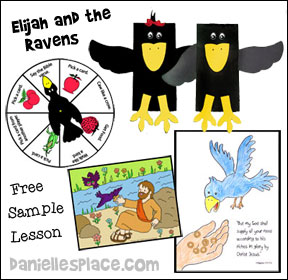
1. Make Crawford the Raven and have a contest to see who can make the craziest looking bird - Have children make Crawford and dress him up to stand out.
What you will need: 4 3/4" x 8 1/2" colored gift bags from a craft store, paint, construction paper, tape or glue, glitter glue, feathers, etc. What to do:
1. Print out the body patterns and cut them out to use as templates. (If you use regular-sized lunch bags print the pattern at 120%) Printing Problems? Place the bag in front of you so that the bag is upside down and the folded flap of the bag is facing forward. Fold the two lower corners of the flap up and behind so they aren't seen and tape them down. Glue beak to the flat between the two folded corners as shown in the picture. Glue the eyes above the beak.
2. Glue or tape the wings onto the sides of the bags and glue the legs to the top of the bag as shown. Have your children add accessories to make their raven stand out. As they work talk about how God wants us to stand out.

Free Sample Lessons
from
The Resource Room
Free
Scaredy Cat
Daniel in the Lion's Den
Free
Go Fish
Sample Sunday School Lesson
Free
Fruit of the Spirit
Sunday School Lesson
Free
Watchdogs
Sunday School Lesson
Free
Consider the Ants
Sunday School Lesson
Free
Ladybug Friends
Sunday School Lesson
Free
Elijah and the Ravens
Sunday School Lesson
Free
The Big Mistake
The Story of the Prodigal Son Sunday School Lesson
Free
The Lost Sheep
Sunday School Lesson
Bug Buddies Studies
For Home School

Twenty-six Bible Lessons for home school, each based on a different animal.
Printable Postcards for
Sunday School
Christian
Wallpaper
for your Computer Desktop

Free Sample Lessons
from
The Resource Room
Free
Scaredy Cat
Daniel in the Lion's Den
Free
Go Fish
Sample Sunday School Lesson
Free
Fruit of the Spirit
Sunday School Lesson
Free
Watchdogs
Sunday School Lesson
Free
Consider the Ants
Sunday School Lesson
Free
Ladybug Friends
Sunday School Lesson
Free
Elijah and the Ravens
Sunday School Lesson
Free
The Big Mistake
The Story of the Prodigal Son Sunday School Lesson
Free
The Lost Sheep
Sunday School Lesson
Bug Buddies Studies
For Home School

Twenty-six Bible Lessons for home school, each based on a different animal.
Printable Postcards for
Sunday School
Christian
Wallpaper
for your Computer Desktop

Free Sample Lessons
from
The Resource Room
Free
Scaredy Cat
Daniel in the Lion's Den
Free
Go Fish
Sample Sunday School Lesson
Free
Fruit of the Spirit
Sunday School Lesson
Free
Watchdogs
Sunday School Lesson
Free
Consider the Ants
Sunday School Lesson
Free
Ladybug Friends
Sunday School Lesson
Free
Elijah and the Ravens
Sunday School Lesson
Free
The Lost Sheep
Sunday School Lesson
Bug Buddies Studies
For Home School
[Home] [Craft Index] [Bible Lessons] [VBS] [Learning Fun ] [Links]