Educational Math Crafts and Activities
How to Make Crafts and Learning Activities Relating to Math
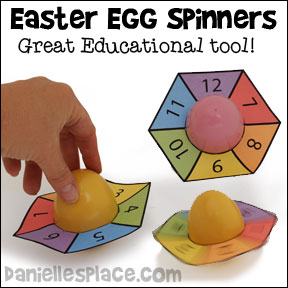
Egg Spinner Math
What you will need:
Printer Paper or Card Stock
Eco Eggs ® - Eco-Friendly Easter Eggs - 12 Count - (Eco eggs® are made in the USA from plants, 100% renewable content.)
Clear Tape
Preparation:
1. Print out the Snag-an-Egg Spinner Pattern.
Colored and Black and White Patterns - Two sizes of patterns to fit just about any large egg.
Member's 
Instant Download all Patterns and Games - 
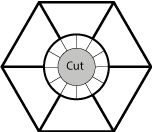
2. Cut out the egg spinner pattern, and then cut out the inside circle of the pattern. Cut the slits on all the little lines that lead to the middle circle.
3. Fold down all the tabs created by cutting the slits.
4. Place the pattern onto the egg so that the rounder part of the egg is the bottom of the spinner and the pointier end is at the top.
5. Use clear tape to tape the spinner pattern to the egg. Place the tape on the tabs.
6. Test out the spinner, if the spinner lands on one side more than the others. Place more tape on the opposite side to help balance the spinner.
Games
1. Add, Subtract, Divide - These spinners can be used to review addition, subtraction, and multiplication facts. Have your children spin each spinner (or one twice) and then add, subtract, or multiply the two numbers that the spinners/spinner lands on. You can use the number at the top of the spinner or the number that is touching the table.
2. Addition Running Total Practice - Children take turns spinning the egg spinner. They write down the number they spin each time and add it to the previous numbers keeping a running total. The player who reaches 100 first wins.
3. Subtraction Running Total Practice - Children take turns spinning the egg. Starting at one hundred they subtract the number they spun keeping a running total. The child who reaches zero first wins.
4. Use Spinner as Die for any Game - Instead of using a die, use the spinner to determine how many spaces to move.
5. Practice Math Families - Use one egg spinner. Children multiply the same number by every number they spin. For example, if you are studying the 5s, have your child multiply every number he spins by 5.
6. Long Division Practice - Use one egg spinner. Start with a large number such as 500. Players divide that number by whatever number they spin, and keep dividing each time they spin a number. The player that gets to zero first wins.
7. Place Value Practice - Spin the Largest Number Game - Have players draw six lines across their papers for place values. You can have them write "one, tens, hundreds . . . etc. next to each line. To play children take turns spinning the spinner. They must write the number they spun on one space trying to make the largest number they can. The player who makes the largest number wins.
©2015, Digital by Design - See Copyright Information
Folding Craft Stick Math Review Game and Craft
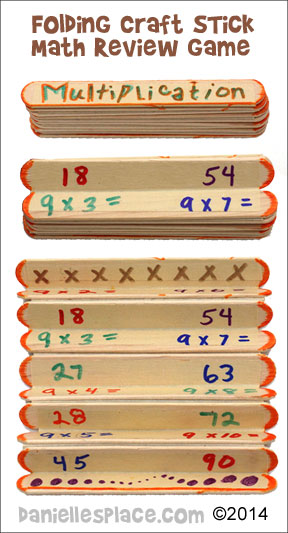
Craft sticks are taped together so that the craft sticks can be folded out to form a canvas on which math facts are written. Children then unfold the canvas as they answer the questions to the math facts to check their answers and then fold them back up again to review them again.
What you will need:
Woodsies Mini Jumbo Craft Sticks -4.5" 50/Pkg - Use good quality craft sticks that lay flat. The 5/8" work perfect with the one-inch tape. *You can use the Woodsies Jumbo Craft Sticks with the 1.5 Inch - 3M Scotch Masking Tape for a bigger Canvas.
3M Scotch Masking Tape, 1-Inch - Other brands will work, but this tape works great! It is the exact color of the craft sticks. (Staple's Tape works better with the washable markers, but it is lighter than the stick and more transparent and doesn't cover the stick as well.)
Permanent Markers in Different Colors
How to Make the Folding Craft Stick Canvas:
1. If you are using the mini-jumbo craft sticks, cut the one-inch masking into 4-inch pieces.
2. Place two sticks together, side by side, long ways, and tape them together covering both the sticks with the tape.
3. Turn the two sticks over so that they are diagonal to you.
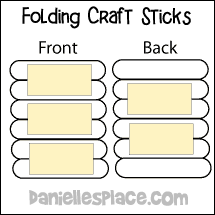
4. Place another craft stick next to and below the two sticks that you taped together. Use another piece of tape to tape the bottom two sticks together.
5. Turn all three sticks over diagonally and place another stick at the bottom of the row and tape the last two sticks together.
Keep going until you have a whole row of sticks.
6. You can also cover the first and last stick in the row by placing tape over the stick and then folding it back over the stick. It is easier to write on the tape than the craft stick. The ink soaks into the sticks and blurs.
7. To prepare the math game spread out the craft stick canvas so that it is laying flat. Fold down the first craft stick toward you and write what type of math fact you will be writing on the sticks such as: addition, multiplication, and subtraction.
8. Fold the first craft stick back up and write two math facts on the second stick from the top. Write the answer to the first two math facts on the next craft stick down, keep writing math facts and answers alternating the facts and answers all the way to the bottom of the craft stick canvas.
To play children fold up all the craft sticks into a pile, then left up the first craft stick to reveal the math facts. The children try to answer the facts and then left up the next craft stick to reveal the answers. Children should keep playing until they can answer all the facts quickly without error.
Watch a video on how to make the folding craft stick canvas.
©2010, Digital by Design, Inc. - See Copyright Information - Bloggers, if you use this craft idea or an adaptation, you must link back to this page for complete directions. If you use this technique, let us know and we will put a link to your blog.
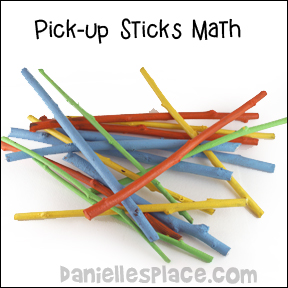
Pick-up Sticks Math
This is a great game because it not only improves your child's math skills, but also improves manual dexterity.
What you will need:
Sticks from Your Trees
Acrylic Paint in Four Different Colors
Paint Brushes
How to Make Pick-Up Sticks:
1. Cut your sticks about seven inches long and divide them into piles according to size. Use at least four sticks per pile. Paint each pile of sticks a different color.
2. Assign different values to each color according to your child's math skills. Play like Pick-up Sticks except when you are all finished have your children add up their scores.
If you have younger children, all the sticks can be worth the same amount. Have your children add up the total number of sticks they have acquired. You can also assign values by 2s, 5s, or 10s and have your children practice counting by these numbers or any other numbers. If you have older children, use odd numbers or numbers that are more difficult to add, and have them practice adding them in their heads
©2007, Digital by Design - See Copyright Information
"Slip the Chip" Printable Math Review Game - Multiples of 9 and 6
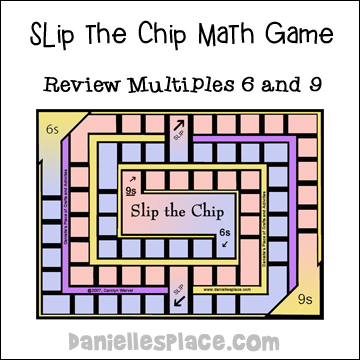
This is a fun way for your children to review their math facts during the summer. They won't even know they are learning!
Two players try to collect as many chips as they can.
They can "slip a chip" from the other player if the number is both a multiple of nine and six.
Member's 
©2007, Digital by Design - See Copyright Information
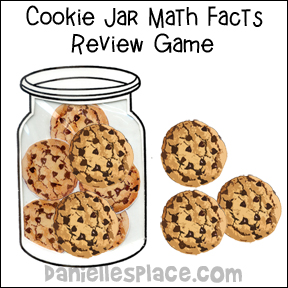
Preparation: Print out the cookie pattern onto card stock and cut out the cookies.
Free
Place ten (or the number of cookies that matches the math fact family you are studying) cookies in a jar.
To play pick a child to start and place his or her name in the following rhyme:
Cookie Jar Math Rhyme
Mattie takes a cookie from the cookie jar.
Mattie says, "Who me? Yummy!
Mattie then takes a handful of cookies and shows the class.
The class asks, "How many cookies do you see?"
Mattie counts the cookies and says how many she has in her hand.
"I see ______ just for me."
The class then asks, "How many cookies did you leave?"
Mattie then subtracts in her head the amount of cookies she has in her hand from the amount that was in the jar (She doesn't get to look in the jar.) and tells the class how many cookies she thinks is left in the jar. "I left __________, I believe.
The class says, "Let's see how many cookies are in the cookie jar."
Mattie then takes the rest of the cookies out of the jar and counts them to see if she is right.
Keep playing until all the children have had a turn.
©2007, Digital by Design - See Copyright Information
"Don't Get Skunked" Spinner Math Game
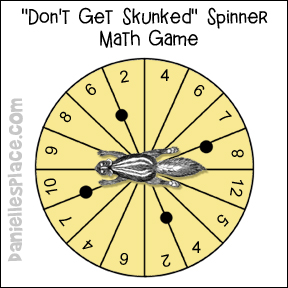
This game can be adapted for children of all skill levels. Teachers fill in the game board with the numbers, addition facts, or multiplication facts their children are studying.
Learn Numbers - Children spin the skunk spinner and tell what number the skunks tail lands on. If they are correct, they get a point or a marker. If the tail lands on a dot, they loose all their points.
Addition Facts - Addition facts can be reviewed in different ways. Children can spin the spinner twice and add the two numbers together and then record that number on a score sheet if they answered correctly. Or they can get one point each time they answer correctly. Or they can keep a running total, spinning the spinner once every turn, and adding that number to their total. If the skunk's tail (or end of the spinner) lands on a dot, the child looses all his points. Or you can tell the children to add the number that the spinner lands on to a certain number. For example, if you are studying your 7's, then have them add seven to the number that the spinner lands on. This works out very well because you can use the same playing board for all the different sets of addition facts.
Multiplication Facts - Multiplication facts can be reviewed in different ways. The children can spin the spinner twice and multiply the two numbers together. If they get it right, they get a point. Or if you are working on certain multiplication facts, for instance, the five's, you can have them multiply the number on the spinner by 5 each time. Or if your child is having problems with certain multiplication facts, you can write those on the playing board to review them. The child would get a point each time he answers one correctly. If the tail of the skunk (or end of the spinner) touches a dot, the child looses all his points and must start again.
To prepare this game draw a circle the size of the inside of a large Styrofoam plate. Cut it out and divide the circle up into sections. Glue the game board onto the top of a large Styrofoam plate or a sturdy box. If you are using a plate, glue another plate to the bottom of the first plate, bottom to bottom. Punch a hole in the plate or box through the center of the game board with a straight pin. Cut out a spinner with an arrow at one end. Place the pin through the middle of the spinner and then place a small bead on the pin. Poke the end of the pin with the bead and spinner on it through the hole in the box. Use pliers to bend the end of the straight pin down so that it doesn't fall out of the plate of box. Write numbers, addition facts, or multiplication facts on the playing board.
A pattern for this game with a skunk spinner is available in the members-only section.
Member's
©2007, Digital by Design - See Copyright Information
"What Can It Be?" Math Review Game
This is a great way to review math facts that your child is having trouble remembering.
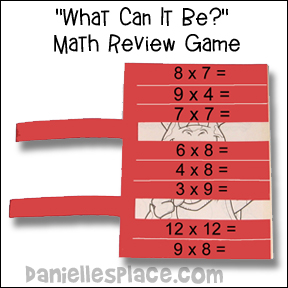
What you will need:
Construction Paper
Pictures from Coloring Books Magazines or Calendars, etc. Calendars etc.
Scissors
How to Make this Math Review Game: Mark off lines one inch apart on a piece of construction paper as shown in the picture. Print one math problem above each line. Cut on the lines leaving one inch from the side of the paper intact. Glue a picture on another piece of construction paper, any size will do, even a very small picture. Then staple the math fact page on top of the picture page. Staple the left-hand side that hasn't been cut so that you can lift up the strips to see what is under them.
Ask your child to pick any math fact on the page and tell you the answer. If he can tell you what the answer is, lift the flap to reveal part of the picture underneath. If he doesn't guess correctly, he should pick another problem. Keep playing until he has discovered what the picture is underneath.
©2007, Digital by Design - See Copyright Information
"Searching for Treasure" Math Game
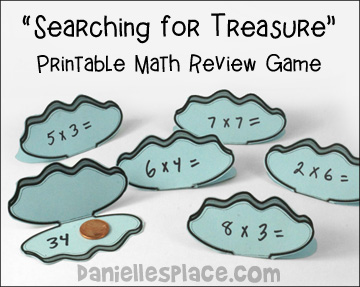
This game can be used for any level. Just write math problems your child is reviewing on the outside of the oysters.
Hide a small treat behind one or more of the oysters.
Your child then points to one of the oysters, answers the equation, and opens it up to see if he is correct and maybe find a treasure.
You can use small pieces of candy, pennies or other coins, seashells, beads to make a necklace, pieces of toys such as Legos, etc. If you don't have small object you can draw a star in one of the oysters and tell you child that if he finds the one with a star, he gets a prize or gets to do something special.
Draw oysters shapes on card stock so that two are connected and you can fold them closed to make the top and bottom of the oyster. Laminate the paper or use contact paper. Cut out the shapes and fold them in half. Use a dry erase marker to write math equations on the outside or the shell so that the opening of the oyster is facing away from you child. When you are done wipe of the equations and save them for another day. A pattern for the oysters is available to members of The Resource Room.
Member's
©2007, Digital by Design - See Copyright Information
Ball Toss Review Game
(This is a great review game for children who have a hard time sitting still.) Purchase a large bouncing ball that is a solid light color. Using a permanent marker write math problems on the ball without answers. (You can also write your child's vocabulary words or other things he is studying.) Outline each problem with a large square or odd shape. You just want to section off the ball into small areas. Toss the ball to your child and have him answer the math problem on which his right thumb is resting. Practice tossing the ball high, low, with one bounce in between, two bounces, three bounces, clapping your hands once before catching the ball, twice, etc. Let your children come up with different ways to practice tossing the ball.
©2007, Digital by Design - See Copyright Information
Reversing Roles Math Review
If your child is getting bored with filling out math worksheets, here's a great way to get him motivated. Before class do the worksheet yourself, except make a lot of errors on the worksheet. Set up the puppet with a pencil in his mouth to look like he is working on the sheet. When your child comes to class tell him that the puppet just finished his math worksheet for him. The only problem is the puppet isn't very good at math so he will have to correct his work. Tell him to show the puppet what he did wrong and teach him how to get the correct answer. Make the puppet not understand very well so your child will really have to work at teaching him.
©2007, Digital by Design - See Copyright Information
Building Blocks Review Game
Review math facts and play at the same time. You will need building blocks or other items that can be stacked such as pennies, books, marshmallows, etc. and math fact cards. Place the building blocks or other objects on a table in front of your child. Tell him that if he answers a math fact correctly he gets to stack a block on top of the pile. If he answers incorrectly, tell him the correct answer and place the math fact card at the bottom of the deck. Keep playing until the stack falls over or your child knows all his facts.
©2007, Digital by Design - See Copyright Information
Puzzle Math
You will need a child's puzzle and a marker. Turn the puzzle pieces over and write the math equations without the answers your child is studying on the back of the puzzle pieces. (This game works best if your child has never used the puzzle before.) Have your child pick one piece of the puzzle at a time and give the answer to the math equation. If he gets it right, he gets to keep the piece. If he gets it wrong, he must return the piece and try it again later. Keep playing until your child has put the entire puzzle together. You can make your own puzzles by gluing pictures from magazines onto cardboard and then cutting them apart.
You can make this game more challenging by telling your child that you are going to keep track of how long it takes him to figure out what the picture on the puzzle is. See if he can beat his record when doing another puzzle. He only gets one guess for each piece of the puzzle he puts together.
You can have your children make their own puzzles for their classmates to figure out. Have them each draw a picture at home and bring it in. Tell them to try to draw a single image not a bunch of little things on the page and to make it big enough to cover the whole page. For instance, they can draw a cat or a dog, but not a cat and a dog. When they bring them back to class glue them onto pieces of cardboard or card stock. Cut them apart into the same sections. You can just use squares if you would like. On the back of the piece write the math facts. Make sure you keep track of who drew the picture so the child that drew the picture doesn't get his own picture. Give each child a puzzle and have him play the review game. The child who figures out what picture his on his puzzle first wins.
You can use the puzzles as a review for the whole class using one puzzle at a time. Let the children take turns picking a piece, answering a question, and then trying to guess what the picture is. Keep track of how long it took the children to figure out what the picture was. The children will be interested to find out who drew the hardest picture to figure out.
©2007, Digital by Design - See Copyright Information
Rainy Day Math Fun
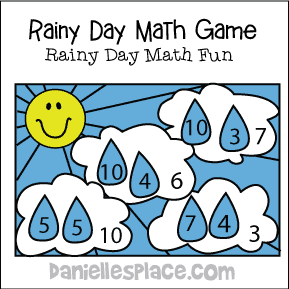
Children learn their math facts by placing raindrops with numbers on them on the clouds so that they are equal to the number on the cloud. This game can be used with any learning level.
What you will need:
Paper
Markers
Scissors
How to make:
1. Before class cut out a bunch of raindrop shapes from blue construction paper. If you would like to make the game so it lasts longer, laminate some sheets of blue construction paper and then cut out the raindrop shapes. Use a permanent ink pen to write the numbers 0 - 10, or 0 - 20, depending on what age group you are preparing the game for. Make at least 5 of each number for each child who will be playing the game. If five children will be playing at one time, make 25 raindrops with "0" on them, 25 raindrops with "1" on them, etc.
2. Find a wide mouth can with a lid such as a can used to hold peanuts. Place the lid on the can and glue cotton balls all over the can. Make sure you don't glue the lid closed. Place the construction paper raindrops inside the can. If you don't want to use a can, you can make a cloud shaped envelope out of white construction paper and laminate it so it will hold up.
3. Print out the cloud cards (Patterns Available to members) and make copies. In class have the children color their cards and write one number on the right side of each cloud. If your children are learning their math facts up to 10, then have them write numbers 0 through 10 on the clouds. If they are learning them up to 20, then have them write numbers 0 through 20. Or have them pick two numbers 0 - 10 and then two numbers 11 - 20 so that they don't pick numbers that are too easy.
Member's
To Play: This game can be played in different ways depending on the level of your children.
The object of the game is to fill your card first with raindrops that either add up to or can be subtracted from another number to equal the number on the cloud. The child who fills up his card first wins. You can just use addition facts or you can use both addition and subtraction. You can limit the amount of raindrops that can be used. You may want to limit younger children to two raindrops. Older children can use more than two raindrops to solve their problems. For example younger children could use 5 + 5 on the "10 cloud" while older children could use 2 + 2 + 6 or 20 - 5 - 5 on the "10 cloud".
©2007, Digital by Design - See Copyright Information
Balancing Math Game
This is a fun way to learn addition, subtraction, and multiplication facts.
What you will need:
Dice
Balancing and Weight Scale
Small Lightweight Objects such as Paper Clips or Game Markers
1. Decide if you want to add, subtract, or multiply the numbers on the dice depending on what your child is learning. If they are learning facts higher than six, you can change some of the numbers on the dice by placing a sticker on the dice and writing new numbers on them. For instance, instead of using the number one, I replaced it with the number seven.
2. To play, each player throws the dice and adds, subtracts, or multiplies the two numbers. He then places that many objects on his side of the scale. The player whose side is the lowest when all the objects are gone wins the game.
You can make a rule that you only pick up the first number of the product or sum of the two dice. For example, if the answer is 36, the player would only pick up three objects and place them on the scale.
©2007, Digital by Design - See Copyright Information
Dice Math


Large Foam Dice to practice addition, subtraction, and multiplication.
Using these large dice is a great way to review math facts with children who have a hard time sitting still. Have your child throw them on the floor and as he goes to retrieve them ask him to add, subtract, or multiply the numbers together. If you have older children, use more than two dice. Use one die for preschool children and just have them add the dots on the die. Children will also enjoy stacking the dice when you
©2007, Digital by Design - See Copyright Information
Math Crafts and Learning Activities on Other Pages